Seleziona la lingua

Schedule D (Form 1040) – Fillable PDF for 2025

  1. Paese Stati Uniti d'America
  2. Lingua Inglese
  3. Attività Le tasse
  4. Dipartimento IRS
Compila questo modulo
Schedule D (Form 1040) – Fillable PDF for 2025

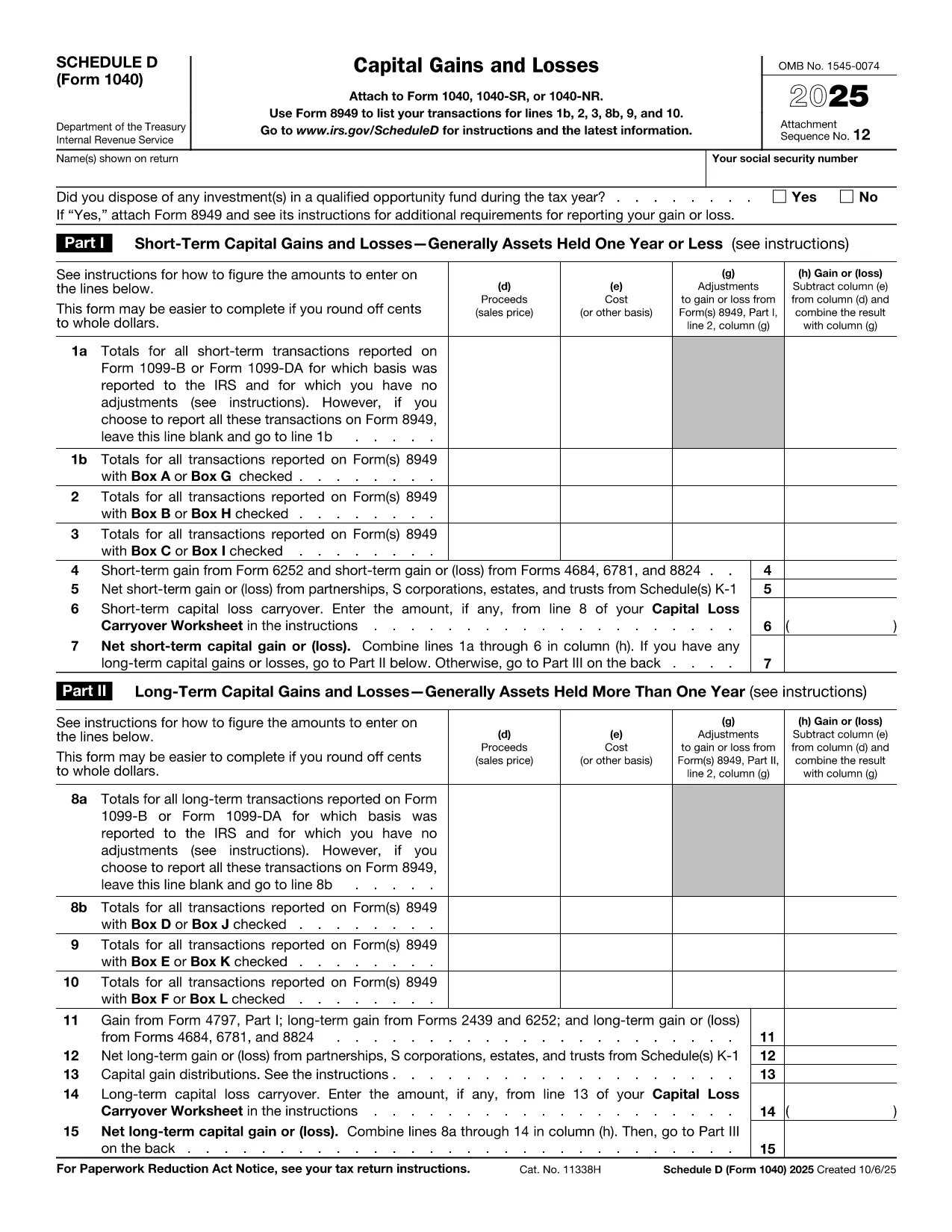
Schedule D (Form 1040) is the IRS worksheet used to report capital gains and losses from the sale of stocks, bonds, real estate, and other investment assets. The 2025 version is now available as a fillable PDF, so you can complete it online without printing.

What Is Schedule D and Who Needs It?

If you sold or exchanged any capital asset during the tax year, you must report the transaction on Schedule D. This includes short‑term gains (held 1 year or less) and long‑term gains (held more than 1 year). Even if you have a net loss, filing Schedule D may allow you to claim a $3,000 deduction against ordinary income.

Step‑by‑Step Guide to Filling Out Schedule D

Follow these simple steps using the fillable PDF on Formize:

  1. Click the Fill out this form button on this page.
  2. Wait for the Formize PDF Filler app to load – it runs directly in your browser.
  3. Enter your short‑term transactions in Part I, using the totals from Form 8949.
  4. Enter your long‑term transactions in Part II.
  5. Review Part III to ensure the net gain or loss is correct.
  6. Save the completed PDF and download it to your computer.

Common Mistakes & Tips for Accurate Reporting

  • Do not mix short‑term and long‑term totals – keep them in separate parts.
  • Double‑check the cost basis; an incorrect basis can inflate your tax.
  • Remember the $3,000 loss limitation; excess loss carries forward to future years.
  • Make sure the totals on Form 8949 match the numbers you enter on Schedule D.

How to Submit Schedule D with Your Tax Return

After completing the PDF, attach it to your Form 1040, Form 1040‑SR, or Form 1040‑NR when you e‑file or mail your return. The fillable PDF preserves the correct layout, so the IRS can read it without issues.

FAQ
  • Do I need Schedule D if I only have a few stock sales?

    Yes, any sale of a capital asset must be reported on Schedule D, even if the gain or loss is small.

  • Can I use the same Schedule D for multiple tax years?

    No, each tax year has its own version. Use the 2025 Schedule D for the 2025 tax year.

  • What is the difference between Part I and Part II?

    Part I reports short‑term gains and losses (held ≤1 year). Part II reports long‑term gains and losses (held >1 year).

  • How do I report a capital loss carryover?

    Enter the carryover amount on line 6 of Part I for short‑term losses or line 14 of Part II for long‑term losses, as shown in the Capital Loss Carryover Worksheet.

  • Is the fillable PDF compatible with Adobe Reader?

    Yes, the PDF follows the IRS standard, but you can fill it directly in the browser using Formize without installing additional software.

  • Where can I find Form 8949?

    Form 8949 is also available on the IRS website; you’ll need it to list each individual transaction before summarizing on Schedule D.

  • What if I made a mistake after filing?

    File an amended return using Form 1040‑X and attach a corrected Schedule D.

COME

Come compilare Schedule D gratuitamente, online in 5 semplici passaggi:

  1. 1
    Open the Fillable Form
    Click the "Fill out this form" button on this page. The Formize PDF Filler will launch directly in your browser.
  2. 2
    Load the PDF Filler
    Wait a few seconds while the Formize app loads the Schedule D PDF. No download or installation is required.
  3. 3
    Enter Your Data
    Complete Part I for short‑term gains, Part II for long‑term gains, and review Part III for the net total.
  4. 4
    Save and Download
    When you finish, click the Save button, then download the completed PDF to your computer.
  5. 5
    Attach to Your Tax Return
    Include the saved Schedule D with your Form 1040 (or 1040‑SR/1040‑NR) when you file your taxes.
App Formize PDF Filler
DI

Moduli fiscali

Schedule D è uno dei moduli fiscali che sono documenti utilizzati per segnalare informazioni sul reddito, sulle detrazioni e sugli obblighi fiscali di un individuo o di un'azienda all'autorità fiscale competente. Questi moduli sono necessari per rispettare le leggi fiscali e adempiere agli obblighi fiscali. I moduli fiscali variano a seconda del Paese e dei requisiti fiscali specifici in vigore. Ecco alcuni tipi comuni di moduli fiscali:

Moduli fiscali individuali: questi moduli vengono utilizzati dai singoli contribuenti per dichiarare il proprio reddito personale e richiedere detrazioni, crediti ed esenzioni. Gli esempi includono il modulo 1040 negli Stati Uniti o il modulo di dichiarazione dei redditi di autovalutazione nel Regno Unito.

Moduli fiscali aziendali: i moduli fiscali aziendali vengono utilizzati da società, società di persone o lavoratori autonomi per segnalare redditi, spese e altre informazioni di natura fiscale. Gli esempi includono il modulo Schedule C (profitti o perdite aziendali) negli Stati Uniti o il modulo CT600 (dichiarazione dei redditi della società) nel Regno Unito.

Moduli relativi alle imposte sui salari: questi moduli vengono utilizzati dai datori di lavoro per segnalare salari, stipendi e imposte trattenute sulle buste paga dei propri dipendenti. Gli esempi includono il modulo W-2 negli Stati Uniti o il modulo P60 nel Regno Unito.

Moduli IVA: i moduli IVA vengono utilizzati dalle aziende per dichiarare e versare l'imposta sulle vendite riscossa su beni o servizi imponibili. I moduli specifici per l'imposta sulle vendite variano in base alla giurisdizione.

Moduli IVA (IVA): i moduli IVA vengono utilizzati nei paesi che impongono un'imposta sul valore aggiunto per dichiarare e versare l'IVA riscossa sulle vendite e richiedere crediti IVA per gli acquisti. Gli esempi includono i moduli di dichiarazione IVA utilizzati in molti paesi.

Moduli stima imposte: i moduli stima imposte vengono utilizzati per segnalare e pagare le imposte stimate sul reddito non soggetto a ritenuta, ad esempio reddito da lavoro autonomo o reddito da investimenti.

Questi sono solo alcuni esempi delle numerose forme fiscali che possono esistere. I moduli specifici richiesti dipendono dalle leggi e dai regolamenti fiscali del tuo Paese o giurisdizione. È importante consultare le linee guida dell'autorità fiscale o chiedere una consulenza professionale per determinare quali moduli sono applicabili alla tua situazione.

CARATTERISTICHE

Compilatore PDF

Il modo più semplice per compilare moduli PDF online

  • Compila rapidamente Schedule D
    Cerchi un modo per compilare rapidamente Schedule D online? Con il nostro compilatore di moduli PDF gratuito online, saprai come modificare e compilare questo documento PDF in meno di un minuto.
  • Editor PDF online facile da usare
    Stufo di stampare file PDF in modo da poterli modificare, prima di riscansionarli e rispedirli? Modifica documenti PDF gratuitamente online. Utilizza il nostro editor PDF online per risparmiare tempo e carta.
  • Grandi strumenti, tutte le piattaforme
    Ti stai chiedendo come inserire Schedule D su un Mac o forse come utilizzare un riempitivo PDF gratuito? I nostri strumenti PDF online funzionano su tutte le piattaforme.
  • Archiviazione sicura dei file
    I file "Schedule D" completati vengono archiviati in un database protetto gestito dall'hosting Amazon Cloud. Puoi eliminare i tuoi file dal nostro sistema in qualsiasi momento. In ogni caso, questi file vengono automaticamente cancellati dopo 24 ore.
  • Chatta con {parola chiave}
    Chatta con "Schedule D" su Chatize che è un assistente di lettura PDF gratuito. Fai domande e ottieni risposte da "Schedule D". Basta fare clic sul pulsante Chatta con il documento in alto.

Elimina sessione di riempimento

Eliminare la sessione di riempimento selezionata? In questo caso, i progressi nella compilazione del modulo andranno persi.

Elimina la sessione di modifica

Eliminare la sessione di editing selezionata? In questo caso, i tuoi progressi nella creazione e modifica del modulo andranno persi.