Select language

Form 706-GS (D-1)

  1. Country USA
  2. Language English
  3. Activity Taxes
  4. Department Internal Revenue Service
Fill out this form
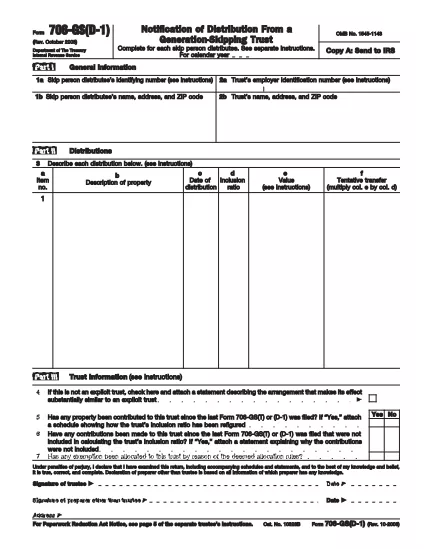
Form 706-GS (D-1)

Notification of Distribution From a Generation-Skipping Trust

Rev. October 2008

This document is related to the reporting of distributions from a Generation-Skipping Trust for each skip person distributee. The document provides instructions on how to complete Form 706-GS(D-1) which is used by a trustee to report distributions to both the Internal Revenue Service and the distributee. The skip person distributee uses this information to complete Form 706-GS(D). The form requires details about each distribution including the date, description of property, value, and inclusion ratio. Trust and distributee's identifying numbers, name, address, and ZIP code are also necessary. The document emphasizes that any errors on Form 706-GS(D-1) should be reported to the trustee for correction.

Instructions

FAQ
  • When does a nonexplicit trust come into play?

    Whenever property is transferred into a pre-existing trust, the inclusion ratio must be refigured. See Multiple transfers into a trust for the rule on how to refigure the inclusion ratio.

  • What does it mean when an arrangement has 'substantially the same effect as a trust'?

    An arrangement that has substantially the same effect as a trust will be treated as a trust even though it is not an explicit trust. Examples of such arrangements are insurance and annuity contracts, life estates and remainders, and estate for years.

  • How is an applicable fraction refigured when property is transferred into a pre-existing trust?

    Whenever property is transferred into a pre-existing trust, the inclusion ratio must be refigured. See Multiple transfers into a trust for the rule on how to refigure the inclusion ratio.

  • What happens when a special QTIP election is made?

    If a special QTIP election has been made, property for which a QTIP election was made for estate or gift tax purposes will be treated as if this QTIP election had not been made. In such cases, either the settlor spouse or the executor of the settlor spouse's estate must make the special QTIP election.

  • What are the rules for computing an applicable fraction for a generation-skipping transfer?

    To compute the applicable fraction for a generation-skipping transfer, you need to determine the denominator (valuation of trust assets) and numerator (allocated GST exemption). The value used in the applicable fraction is the gift tax value for an inter vivos transfer if the allocation was made on a timely filed gift tax return. If the QTIP election has been made, the surviving spouse is considered the transferor, and the value is the estate tax value. If there was an ETIP, the value of the property for computing the inclusion ratio is the estate tax value if the property is includible in the transferor's gross estate.

  • What is a generation-skipping transfer (GST)?

    A generation-skipping transfer (GST) occurs when property is transferred from a grandparent to a grandchild, bypassing the parents in the next generation. GSTs can have significant federal estate and gift tax consequences.

  • What is the purpose of requesting information from taxpayers about their offshore activities?

    The IRS has issued final regulations under section 6011 regarding the reporting obligations with respect to foreign financial assets, which includes bank accounts, investment accounts, and other types of foreign financial assets. These regulations require U.S. taxpayers who have a financial interest in, or signature authority over, certain foreign financial assets held for their own benefit or for the benefit of an immediate family member to report that interest on Form 8938.

  • What type of trust is this form used for?

    Form 706-GS (United States Estate (and Certain Nonresident Not a Citizen) and Generation-Skipping Transfer Tax Return) is used to report transfers into a grantor trust or a generation-skipping transfer trust.

  • What information should be entered in column a?

    Enter the name, title, and SSN (if applicable) of the person making the transfer or the estate of the deceased person.

  • Who is considered the transferor for GST tax purposes?

    The transferor for GST tax purposes depends on the type of trust and whether a special QTIP election was made. For a grantor trust, the transferor is typically the person making the transfer. For a generation-skipping transfer through a trust, it could be the original settlor or the surviving spouse of the settlor, depending on the circumstances.

  • What is the inclusion ratio?

    The inclusion ratio is used to determine the amount of generation-skipping transfer tax that applies to a transfer. It is calculated by dividing the total generation-skipping transfer tax exemption by the sum of the value of all transfers made during the person's lifetime and the adjusted GST exemption (in case of late allocation).

HOW TO

How to fill out Form 706-GS (D-1) for free, online in 3 easy steps:

  1. 1
    Open form template in editor
    Click on the “Get this template” button.
  2. 2
    Fill out Form 706-GS (D-1)
    Wait a moment and you will be redirected to our online PDF Filler app.
  3. 3
    Download file
    Download your completed Form 706-GS (D-1) for free. You can also save it to a cloud storage.
Formize PDF Filler app
ABOUT

Internal Revenue Service (IRS) Forms

Form 706-GS (D-1) is one of the official tax forms used in the United States to report income, claim deductions and credits, calculate tax liability, and fulfill other tax-related obligations. The IRS is the federal agency responsible for administering and enforcing the internal revenue laws in the United States.

Here are some examples of Internal Revenue Service forms:

Form 1040: This is the primary individual income tax return form used by most taxpayers. It is used to report various types of income, claim deductions and credits, calculate tax liability, and determine whether a taxpayer owes additional tax or is entitled to a refund.

Form 1099: There are different variations of Form 1099, such as 1099-MISC, 1099-INT, 1099-DIV, etc. These forms are used to report income received by individuals or businesses from various sources other than employment, such as self-employment income, interest income, dividend income, and rental income.

Form W-2: This form is used by employers to report wages paid to employees and the taxes withheld from their pay. Employees use the information on Form W-2 to complete their individual tax returns.

Form 941: Employers use this form to report employment taxes, including federal income tax withheld, Social Security tax, and Medicare tax, for their employees.

Form 1065: This form is used by partnerships to report their income, deductions, and tax liability. Partnerships themselves do not pay income tax; instead, the partners report their share of partnership income on their individual tax returns.

Form 1120: This is the corporate income tax return form used by C corporations to report their income, deductions, and tax liability.

Form 990: This form is used by tax-exempt organizations, such as nonprofits and charities, to report their financial information, activities, and compliance with tax laws.

Form 8862: This form is used by taxpayers who previously claimed the Earned Income Tax Credit (EITC) but had it disallowed, and now want to claim it again.

These are just a few examples of the numerous IRS forms that exist to fulfill various tax-related obligations. The specific forms required for an individual or business depend on their unique circumstances, income sources, and deductions. It's advisable to consult the official website of the Internal Revenue Service (www.irs.gov) or seek professional tax advice to obtain accurate and up-to-date information regarding the specific IRS forms relevant to your tax situation.

FEATURES

PDF Filler

The easiest way to fill Form 706-GS (D-1) online

  • Quickly fill out Form 706-GS (D-1)
    Looking for a way to quickly fill Form 706-GS (D-1) online? With our online free PDF form filler, you’ll know how to how to edit and fill this pdf document in less than a minute.
  • Easy to use online PDF editor
    Fed up with printing out PDF files so you can edit them, before rescanning and sending them back? Edit PDF documents for free online. Use our online pdf editor to save time and paper.
  • Great tools, all platforms
    Wondering how to fill in Form 706-GS (D-1) on a Mac, or maybe how to use a PDF filler free? Our online PDF tools work on all platforms.
  • Secure file storage
    Completed "Form 706-GS (D-1)" files are stored in a secured database managed by Amazon Cloud hosting. You can delete your files from our system anytime. In any case, these files are automatically deleted after 24 hours.
  • Chat with Form 706-GS (D-1)
    Chat with "Form 706-GS (D-1)" on Chatize that is a free PDF reader assistant. Ask questions and get answers from "Form 706-GS (D-1)". Just click on Chat With Document button above.

Delete filling session

Delete the selected filling session? In this case, your progress in completing the form will be lost.

Delete editing session

Delete the selected editing session? In this case, your progress in creating and editing the form will be lost.