Select language

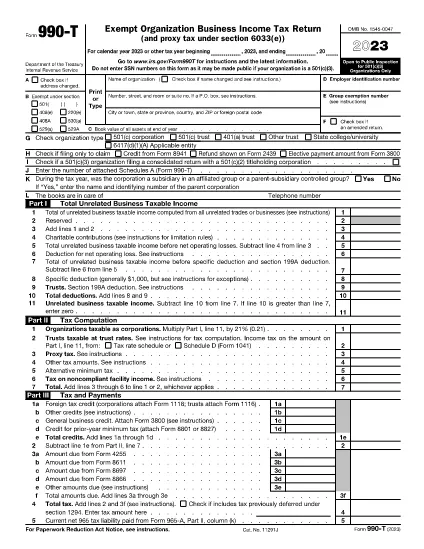
Form 990-T

  1. Country USA
  2. Language English
  3. Activity Taxes
  4. Department Internal Revenue Service
Fill out this form
Form 990-T

Exempt Organization Business Income Tax Return (and proxy tax under section 6033(e))

Rev. 2023

Form 990-T is an IRS tax form used by organizations that have unrelated business income to report. The form includes instructions for calculating taxes owed, reporting payments and credits, and providing additional information regarding certain activities and other information.

Instructions

  • Form 990-T Instructions - Instructions for Form 990-T, Exempt Organization Business Income Tax Return (and Proxy Tax Under Section 6033(e))
FAQ
  • What information is reported on Form 1120-T?

    Form 1120-T includes sections reporting various items such as income from sources inside and outside the United States, deductions, credits, adjustments to gross income, tax due, payments, and other relevant information for trusts and estates.

  • What is the definition of a 501(c)(3) organization?

    A 501(c)(3) organization refers to a charitable, religious, educational, scientific, or literary nonprofit organization as defined by section 501(c)(3) of the Internal Revenue Code. These organizations are exempt from federal income tax and may receive tax-deductible donations.

  • What is the purpose of Supplemental Information in Form 990?

    The Supplemental Information section of Form 990, also known as Schedule R, is designed to provide additional information about the organization's programs and activities. It allows organizations to provide more context on their operations beyond what is required in Part II.

  • What are the three main parts of the Form 990?

    The three main parts of the Form 990 are: (1) Part I, which gathers information about the organization's governance, such as its officers and directors; (2) Part II, which covers financial data related to the organization's income, expenses, assets, liabilities, and net assets; and (3) Part III, which involves reporting on the organization's programs, activities, and compensation of certain employees.

  • What is the public inspection requirement for 501(c)(3) organizations?

    Under section 501(c)(3) of the Internal Revenue Code, 501(c)(3) organizations are required to make their tax-exempt application and supporting documents available for public inspection. This requirement ensures transparency and accountability for the organization's activities.

  • What is a qualified trust?

    A qualified trust is a trust exempt from federal income tax under section 501(c)(3) of the Internal Revenue Code. These trusts are typically created for religious, educational, charitable, scientific, literary, or other similar purposes.

  • Which organizations are required to file Form 1120-T?

    Trusts and estates having an unadjusted gross income of more than $600 during the tax year are required to file Form 1120-T.

  • What is Form 1120-T used for?

    Form 1120-T, U.S. Income Tax Return for Certain Trusts and Estates, is used to report income, deductions, credits, and payments for trusts and estates that are required to file an income tax return.

  • What are some common mistakes made by trust filers while preparing Form 990?

    Some common mistakes made by trust filers while preparing Form 990 include: (1) Failure to report accurate information about the organization's finances and activities; (2) Missing or incomplete documentation in Part I, II, or III; (3) Inadequate

  • What are some common deductions for trusts and estates?

    Common deductions for trusts and estates include income received in exchange for services, distributions to beneficiaries, deductible expenses for administering the estate or trust, and charitable contributions. However, the rules can be complex and may depend on the specific circumstances of each case.

  • What are the deadlines to file Form 1120-T?

    Form 1120-T is generally due on April 15 of the year following the trust or estate's taxable year. However, if the trust or estate is a fiscal-year taxpayer, the return is due on the 15th day of the fourth month following the end of its fiscal year.

  • What is a trust or estate?

    A trust is a legal arrangement where one party, called the trustor, transfers assets to another party, called the trustee, to manage and distribute those assets for the benefit of a third party, called the beneficiary. An estate refers to the assets of a deceased person that are managed and distributed according to the decedent's will or the laws of intestacy if there is no will.

  • What is the Form 990 series?

    The Form 990 series is a set of IRS tax return forms that apply to various types of nonprofit organizations, including 501(c)(3) organizations. The Form 990 is used to report information about the organization's financial activities, governance, and programs.

  • What is the difference between a 501(c)(3) organization and other nonprofit types?

    The main difference between a 501(c)(3) organization and other nonprofit types, such as 501(c)(4) or 501(c)(22), is that 501(c)(3) organizations are limited to specific charitable, religious, educational, scientific, or literary purposes, whereas other nonprofit types may engage in any lawful activity. This distinction determines their tax-exempt status and the extent of their fundraising opportunities.

HOW TO

How to fill out Form 990-T for free, online in 3 easy steps:

  1. 1
    Open form template in editor
    Click on the “Get this template” button.
  2. 2
    Fill out Form 990-T
    Wait a moment and you will be redirected to our online PDF Filler app.
  3. 3
    Download file
    Download your completed Form 990-T for free. You can also save it to a cloud storage.
Formize PDF Filler app
ABOUT

Internal Revenue Service (IRS) Forms

Form 990-T is one of the official tax forms used in the United States to report income, claim deductions and credits, calculate tax liability, and fulfill other tax-related obligations. The IRS is the federal agency responsible for administering and enforcing the internal revenue laws in the United States.

Here are some examples of Internal Revenue Service forms:

Form 1040: This is the primary individual income tax return form used by most taxpayers. It is used to report various types of income, claim deductions and credits, calculate tax liability, and determine whether a taxpayer owes additional tax or is entitled to a refund.

Form 1099: There are different variations of Form 1099, such as 1099-MISC, 1099-INT, 1099-DIV, etc. These forms are used to report income received by individuals or businesses from various sources other than employment, such as self-employment income, interest income, dividend income, and rental income.

Form W-2: This form is used by employers to report wages paid to employees and the taxes withheld from their pay. Employees use the information on Form W-2 to complete their individual tax returns.

Form 941: Employers use this form to report employment taxes, including federal income tax withheld, Social Security tax, and Medicare tax, for their employees.

Form 1065: This form is used by partnerships to report their income, deductions, and tax liability. Partnerships themselves do not pay income tax; instead, the partners report their share of partnership income on their individual tax returns.

Form 1120: This is the corporate income tax return form used by C corporations to report their income, deductions, and tax liability.

Form 990: This form is used by tax-exempt organizations, such as nonprofits and charities, to report their financial information, activities, and compliance with tax laws.

Form 8862: This form is used by taxpayers who previously claimed the Earned Income Tax Credit (EITC) but had it disallowed, and now want to claim it again.

These are just a few examples of the numerous IRS forms that exist to fulfill various tax-related obligations. The specific forms required for an individual or business depend on their unique circumstances, income sources, and deductions. It's advisable to consult the official website of the Internal Revenue Service (www.irs.gov) or seek professional tax advice to obtain accurate and up-to-date information regarding the specific IRS forms relevant to your tax situation.

FEATURES

PDF Filler

The easiest way to fill Form 990-T online

  • Quickly fill out Form 990-T
    Looking for a way to quickly fill Form 990-T online? With our online free PDF form filler, you’ll know how to how to edit and fill this pdf document in less than a minute.
  • Easy to use online PDF editor
    Fed up with printing out PDF files so you can edit them, before rescanning and sending them back? Edit PDF documents for free online. Use our online pdf editor to save time and paper.
  • Great tools, all platforms
    Wondering how to fill in Form 990-T on a Mac, or maybe how to use a PDF filler free? Our online PDF tools work on all platforms.
  • Secure file storage
    Completed "Form 990-T" files are stored in a secured database managed by Amazon Cloud hosting. You can delete your files from our system anytime. In any case, these files are automatically deleted after 24 hours.
  • Chat with Form 990-T
    Chat with "Form 990-T" on Chatize that is a free PDF reader assistant. Ask questions and get answers from "Form 990-T". Just click on Chat With Document button above.

Delete filling session

Delete the selected filling session? In this case, your progress in completing the form will be lost.

Delete editing session

Delete the selected editing session? In this case, your progress in creating and editing the form will be lost.